

Modern businesses depend on technology and electronic assets to keep daily operations running smoothly. From employee devices and business hardware to critical equipment, even a small technical issue can affect productivity, customer service, and operational continuity.
As the number of devices and service requests grows, managing repairs, work orders, warranties, inventory, and procurement through disconnected systems can become increasingly difficult. Businesses need a structured approach that connects every stage of the service process.
End-to-end service management brings these activities together in one connected workflow, giving organizations greater visibility, faster response times, and better control over their assets and service operations. Praise Group provides integrated IT management solutions covering procurement, inventory tracking, warranty management, after-sales support, analytics, and business-system integrations.
What Is End-to-End Service Management?
End-to-end service management is a structured approach to managing the complete service lifecycle, from the moment an issue is reported to its resolution and follow-up.
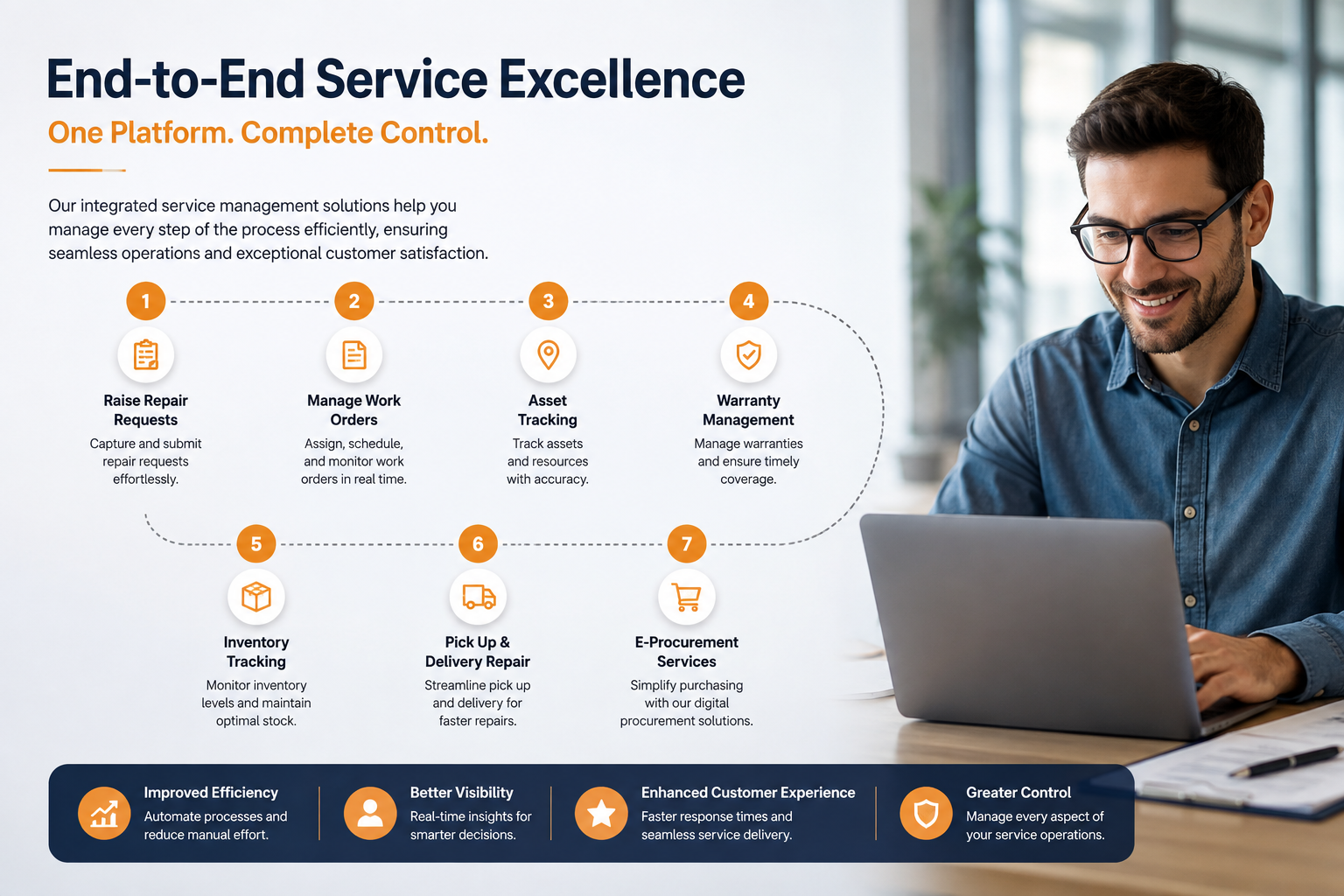
A connected service workflow can include repair requests, work order management, asset tracking, warranty management, inventory control, device pickup and delivery, and e-procurement.
Instead of managing each activity separately, businesses can connect these processes so information moves smoothly between teams and departments.
This creates a more organized environment where employees can report issues, service teams can manage repairs, and decision-makers can monitor operations from a centralized system.
Why Businesses Need Connected Service Operations
Manual service processes often create unnecessary delays. A repair request may begin through email, move to a separate spreadsheet, require another system for warranty verification, and then depend on manual communication for inventory or procurement.
This fragmented approach makes it difficult to understand the current status of an asset or service request.
A connected service management platform can eliminate many of these information gaps by bringing service activities into a unified workflow. Businesses can gain better visibility into service requests, repair progress, asset status, inventory, and warranties.
From Repair Request to Resolution
A strong service management process begins with a simple way to report an issue.
Employees or customers can submit repair requests through a centralized system. Once a request is received, it can be assigned to the appropriate team and converted into a work order.
Service teams can then monitor the progress of the repair, track the relevant asset, check warranty coverage, and coordinate required parts or services.
This connected approach reduces the possibility of requests being overlooked and provides greater transparency throughout the repair journey.
Smarter Work Order Management
Work orders are an important part of service operations because they connect a reported issue with the actions required to resolve it.
Without proper work order management, service teams may struggle with unclear responsibilities, missed deadlines, or limited visibility into repair progress.
Digital work order management allows organizations to assign tasks, monitor progress, manage deadlines, and maintain service records.
With better coordination, businesses can improve response times and reduce the operational impact of device and equipment problems.
Better Asset Tracking and Visibility
Businesses often manage hundreds or thousands of technology assets across different employees, departments, and locations.
Knowing where an asset is, what condition it is in, whether it is under warranty, and what service history it has can be essential for effective asset management.
Real-time asset tracking provides greater visibility into equipment and resources. Praise Group's platform supports IT asset visibility through features including barcode and RFID support, location tracking, and automated depreciation calculations.
Better asset visibility can help businesses make more informed decisions about repairs, replacements, maintenance, and future technology investments.
Making Warranty Management More Efficient
Warranty information is another important part of the service lifecycle.
When warranty dates are tracked manually, businesses may miss coverage periods or pay for repairs that could have been covered by the manufacturer or vendor.
Automated warranty management can help organizations monitor warranty periods, receive expiration alerts, manage claims, and coordinate with vendors.
This can reduce unnecessary maintenance costs while helping organizations get greater value from their technology investments.
Keeping Inventory Connected to Service Operations
Repair operations often depend on having the right replacement parts and equipment available at the right time.
If inventory information is disconnected from repair management, service teams may face delays while waiting for parts or discovering that required items are unavailable.
Connecting inventory tracking with service workflows provides better visibility into available resources and helps organizations plan maintenance more efficiently.
It can also help reduce unnecessary inventory and improve resource utilization.
Streamlining Pickup and Delivery Repairs
For businesses that use device pickup and delivery services, logistics can become another important part of the repair lifecycle.
A connected service workflow can coordinate device collection, repair status, and delivery so that employees and customers have greater visibility into the process.
Praise Group offers flexible repair options, including on-site repair, pickup, and drop-off services, while its service solutions are designed to provide real-time repair tracking.
Faster coordination can help minimize downtime and get devices back into operation sooner.
Connecting Procurement With Service Management
Service management does not stop at repairs.
Organizations may need to purchase replacement devices, spare parts, accessories, or other equipment as part of the service process.
E-procurement connects purchasing activities with operational requirements. Automated purchasing workflows, vendor management, and approval systems can reduce manual effort and improve purchasing accuracy.
When procurement and service management work together, businesses can create a more complete lifecycle for their technology assets.
Improving Operational Efficiency
One of the biggest benefits of end-to-end service management is improved operational efficiency.
Automation can reduce repetitive administrative work, while centralized information helps teams spend less time searching for updates or coordinating information across multiple systems.
Real-time visibility also enables managers to identify delays and service bottlenecks more quickly.
By connecting repair management, asset tracking, warranty monitoring, inventory, and procurement, businesses can create a more efficient operational environment.
Reducing Downtime
Technology downtime can affect employee productivity, customer experience, and business continuity.
A delayed repair can prevent an employee from working effectively or interrupt an important business process.
End-to-end service management helps reduce these disruptions by providing structured workflows for reporting issues, assigning work, tracking repairs, and coordinating resources.
Faster issue resolution means employees can return to productive work sooner and organizations can maintain more consistent operations.
Creating Better Service Experiences
Service management is not only about internal efficiency. It also affects the experience of employees and customers.
When users can report issues easily, receive updates, and track service progress, they have greater confidence in the support process.
For service teams, centralized information provides the context needed to respond more effectively.
Praise Group's solutions include integrated ticketing, SLA tracking, customer communication capabilities, and real-time service visibility designed to support more consistent service experiences.
The Role of Analytics and Automation
Modern service management is becoming increasingly data-driven.
Analytics can help organizations understand repair volumes, service performance, asset conditions, warranty trends, and operational bottlenecks.
With better data, businesses can identify recurring issues and make more informed decisions about maintenance, replacement, inventory, and resource planning.
Praise Group provides customizable dashboards and reporting capabilities, along with predictive analytics for decision-making and resource planning.
Integration With Existing Business Systems
Service management becomes even more valuable when it can connect with existing business software.
Businesses may already use ERP, CRM, accounting, inventory, and other operational systems. Connecting these platforms can reduce duplicate data entry and create a more consistent flow of information.
Praise Group's platform is designed to integrate with ERP, CRM, and accounting systems through APIs and pre-built connectors.
This allows organizations to build a connected technology environment rather than adding another isolated system.
The Future of Service Management
The future of service management is moving toward greater automation, predictive maintenance, real-time analytics, and connected asset ecosystems.
Instead of waiting for equipment to fail, organizations can increasingly use data and intelligent systems to identify potential issues earlier.
Predictive insights can help businesses plan maintenance, optimize resources, reduce unexpected downtime, and extend asset lifecycles.
As organizations become more dependent on technology, these capabilities will become increasingly important for maintaining efficient and reliable operations.
Conclusion
End-to-end service management gives businesses a structured way to connect repair requests, work orders, asset tracking, warranties, inventory, logistics, and procurement. Instead of managing each activity separately, organizations can create a connected workflow that improves visibility and operational control.
With integrated service management, businesses can respond to issues faster, reduce downtime, improve asset utilization, manage warranties more effectively, and provide better service experiences. Praise Group's integrated IT management approach brings these capabilities together to help organizations simplify service operations and improve long-term efficiency.
A connected service lifecycle is more than a way to manage repairs. It creates a stronger operational foundation where every request, asset, repair, and resource can work together toward more reliable business performance.


Leave a reply